


═══════════════════════════════════════════
THE RULE NOBODY LIKES
═══════════════════════════════════════════
Every mechanical system has one rule its users quietly resent. In KISS,
it’s LVTD.
Not because it’s complicated — it’s the simplest rule we have. You resent
it because it’s the only rule that regularly acts against you in a way you
can SEE, while protecting you in a way you can’t. It makes you sell when
part of you wants to hold. It sometimes takes you out for a small LOSS on
a trade that “might have worked.” And it asks you to do this again and
again, mechanically, on faith.
This article is about why that discomfort is not a flaw in the rule. It’s
the entire reason the rule works. And this week handed me four live
examples — two saves, one small green exit, and one exit taken at a loss —
so I’m going to show you all four, exactly as they happened.
═══════════════════════════════════════════
WHAT LVTD ACTUALLY ASKS OF YOU
═══════════════════════════════════════════
A quick refresher. A breakout only means something if institutions are
buying it. But your broker fills you on PRICE, intraday, long before the
day’s VOLUME is known. So you can be “in” a breakout that nobody is
actually funding.
LVTD closes that gap. On the day you get filled, at 15:45 ET you check
cumulative volume against 1.5× the 20-day average. If it’s there, the move
is real — you hold. If it’s not, you sell at market at 15:55 ET. Green or
red. No discretion.
Read that last part again: green OR RED. The gate doesn’t care whether
you’re up or down when it fires. You act BEFORE you know how the story
ends — which means you will sometimes take a small loss on a trade that,
in hindsight, might have recovered. The rule accepts that trade. Most
traders can’t. That’s the whole psychological problem in one sentence.
═══════════════════════════════════════════
THE COSTS YOU CAN SEE
═══════════════════════════════════════════
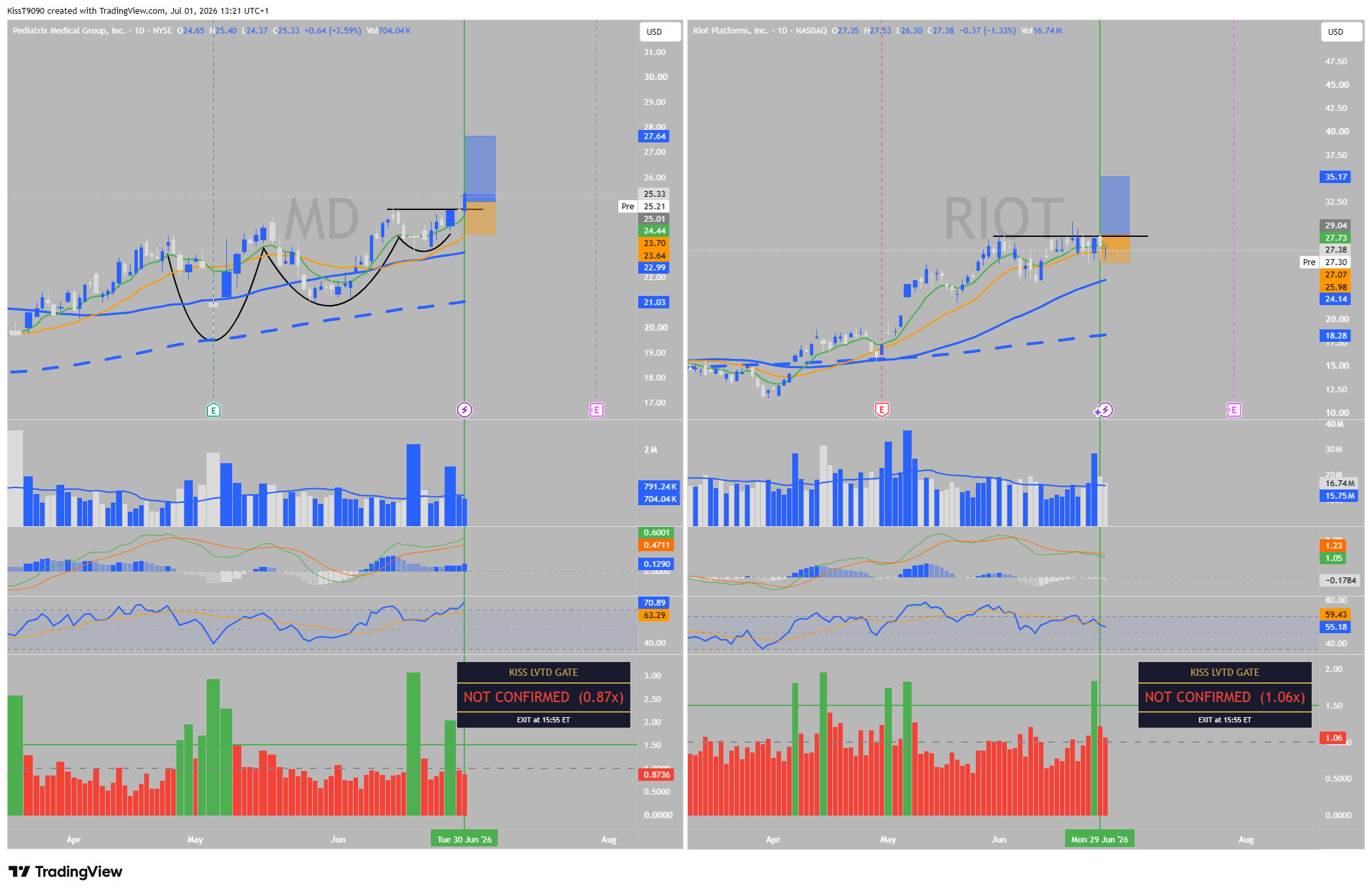
Let me be honest about what LVTD cost me this week, in full view.
COST #1 — TAKING A SMALL LOSS ON PURPOSE (RIOT)
RIOT filled. By 15:45 ET the volume wasn’t there — the gate read below
1.5×. So I sold at 15:55 ET, and I sold at a LOSS: −0.47R. Sitting there,
closing a position in the red because “the volume is light,” while the
chart still looks fine, is the single hardest click in the system. Every
instinct says give it one night to work.
COST #2 — CUTTING A GREEN TRADE SHORT (MD)
MD broke out, filled, and again the volume failed the gate. I exited five
minutes before the close for +0.17R. A tiny green — the kind of result
that feels like leaving money on the table. Why sell a winner over
“volume”?
Both of these are REAL costs. One cost me part of an R; the other cost me
the feeling of letting a winner run. I’m not going to pretend LVTD is
free. It isn’t. It has a price, and this week I paid it twice, in public.
═══════════════════════════════════════════
THE COSTS YOU CAN’T SEE (AND WHY THEY’RE BIGGER)
═══════════════════════════════════════════
Now the other side of the same week: NVT and ETN.
Both filled. Both failed the volume gate. Both got the same mechanical
15:55 exit — booked at +0.29R and +0.15R. And here’s the part you almost
never get to see: both of those stocks are now trading BELOW the stops I
would have been holding overnight. If I’d “given them room,” both would
have been clean −1R losses, maybe worse on a gap. The gate turned two
−1R traps into two small wins.
That’s the invisible benefit made visible for once. Normally you NEVER get
this proof. You exit on low volume, the stock quietly fades, and you never
feel the −1R you dodged — because it never hit your account. A loss that
doesn’t happen leaves no mark, no screenshot, no sting.
So look at the asymmetry across all four trades:
→ RIOT: visible −0.47R. But it capped a trade with no institutional
support before it could become a full −1R.
→ MD: visible +0.17R, felt like a “miss.”
→ NVT + ETN: two −1R losses that SILENTLY never happened.
The costs are loud, immediate, visible. The benefits are silent, delayed,
invisible. Your brain is built to overweight the loud thing and ignore the
silent one — that’s not a personal weakness, it’s every human’s default.
The entire job of a mechanical rule is to override that default for you.
═══════════════════════════════════════════
THE INSURANCE ANALOGY
═══════════════════════════════════════════
Think about insurance. Every month you pay a premium for a fire that
doesn’t come. Judged purely on visible outcomes, you’d cancel it — it
“wastes” money eleven months a year. But nobody sane cancels their fire
insurance the week before the fire, because you can’t know which week the
fire comes.
LVTD is insurance. RIOT’s −0.47R and MD’s cut-short winner ARE the
premium — small, regular, slightly annoying. NVT and ETN are the claim
you didn’t have to file, because the policy was already in force. You are
not paying to be right on every trade. You are paying so that no single
low-volume trap can take a full R out of your account.
A rule you only follow when it’s convenient is not insurance. It’s a
policy you cancelled the morning of the fire.
═══════════════════════════════════════════
THE DOOR STAYS OPEN
═══════════════════════════════════════════
Here’s what resolves the “but RIOT/MD might still run” pain: LVTD does not
kill the thesis. It ends ONE unconfirmed session, not the trade idea.
If a name you exited sets up again and breaks out on real volume, you get
back in. You miss the first, unfunded push — not the move.
But the door only opens for a NEW valid setup, never a chase. Take MD:
it’s now extended and overbought after two green days. Re-entering at
today’s price would push the R:R below 1:2 — so the same discipline that
got me OUT also stops me from jumping back in badly. The rule protects you
on both ends: it won’t let you hold a trap, and it won’t let you chase the
regret.
═══════════════════════════════════════════
WHY IT ONLY COUNTS WHEN IT HURTS
═══════════════════════════════════════════
Anyone can follow a rule that’s free. Holding a high-volume winner
overnight takes no willpower — the rule and your greed agree.
The system is defined entirely by what you do the day the rule COSTS you.
Selling RIOT at a −0.47R because the volume said so. Cutting MD green
instead of gambling on the overnight. Those clicks — the uncomfortable
ones — are the reps that separate a trader who HAS a system from a trader
who has a rulebook they abandon under pressure.
Following LVTD right after it just handed you a loss isn’t you being
rigid. It’s you proving — to the only person watching, which is you — that
the rule is real. Break it once because “this one’s obviously fine,” and
it stops being a system. It becomes a suggestion you overrule whenever you
feel confident. And feeling confident at exactly the wrong moment is how
most accounts die.
═══════════════════════════════════════════
THE TAKEAWAY
═══════════════════════════════════════════
This week LVTD cost me a −0.47R on RIOT and a cut-short winner on MD. It
also quietly saved me two −1R losses on NVT and ETN that I’ll never have
to feel.
I could not know in advance which trade would be which — so I followed the
gate on all four, identically, including the two where it hurt. That’s the
point. The discomfort isn’t the rule failing. The discomfort IS the rule
working.
Trade the process. The outcomes take care of themselves.
───────────────────────────────────────────
Trade Tight · Think in R · Focus on Process
Trade Tight, RB
───────────────────────────────────────────
⚠️ Educational only. Not financial advice. Examples are from my own paper
sprint and illustrate process, not trade recommendations. Always DYOR.