

═══════════════════════════════════════════
WHY 90% OF RETAIL LOSES
═══════════════════════════════════════════
Most people don’t lose in the market because they’re not smart enough.
They lose because they have no process.
They buy a tip from a friend. They chase a stock because it was on the
news. They “feel” that something is going up. Every decision is made in
the moment, under pressure, driven by emotion — and the market punishes
exactly that.
Professionals do the opposite. They don’t predict. They don’t guess. They
run every potential trade through a fixed grid of filters, and if the
trade doesn’t clear every filter, they don’t take it. No exceptions. No
“just this once.”
That’s what the KISS system is: a clinical, mechanical grid that turns the
chaos of the market into a binary question — YES or NO. Take the trade, or
stand aside. Nothing in between.
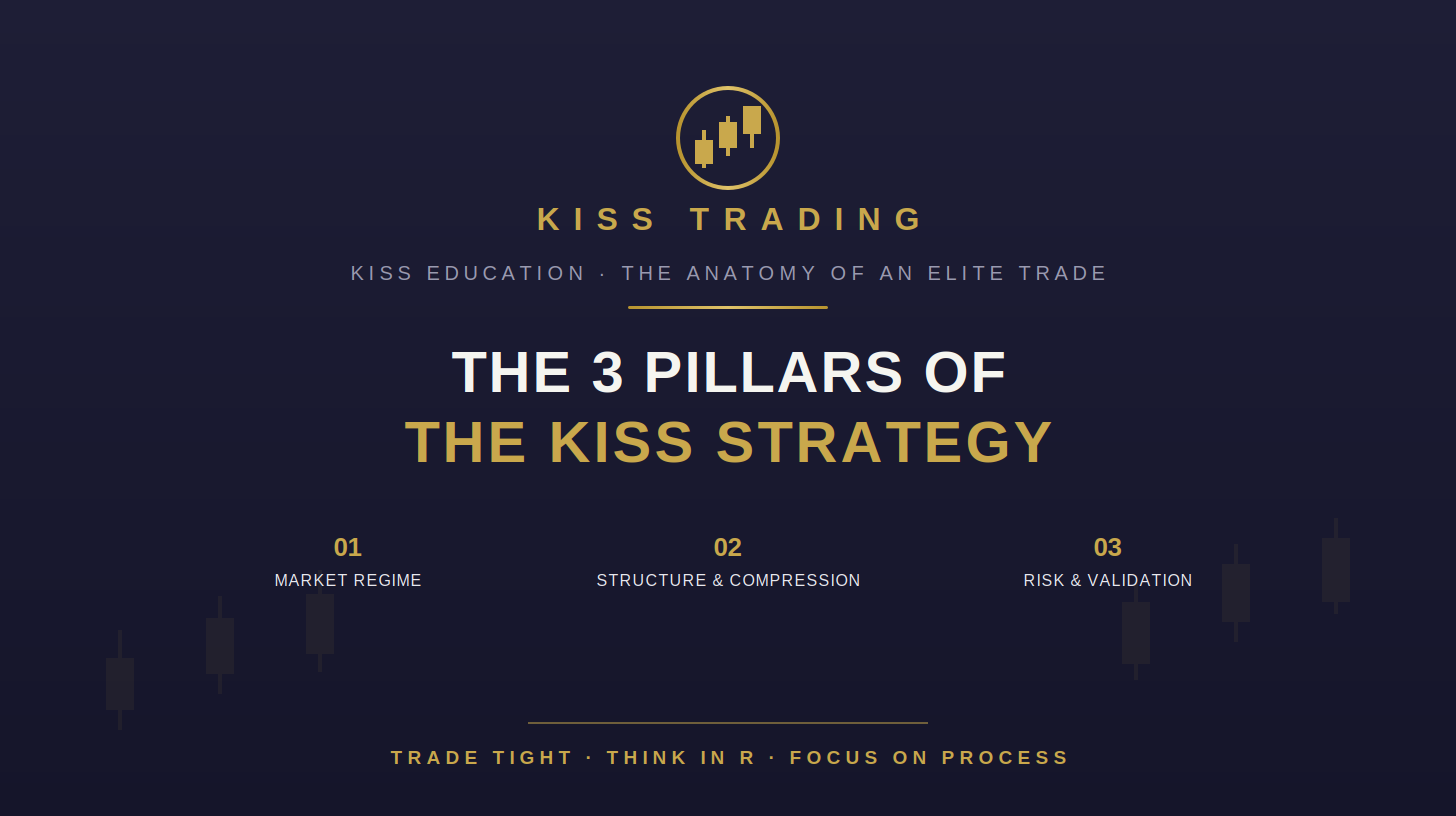
It rests on three pillars. Miss any one of them, and the trade is a no.
═══════════════════════════════════════════
PILLAR 1 — MARKET REGIME
“Never swim against the current.”
═══════════════════════════════════════════
Before we look at a single stock, we ask one question: which way is the
tide going?
No trader — however good — beats a hostile market for long. A great setup
in a falling market is a losing trade waiting to happen. So the first
filter is the biggest one: is the broader market healthy?
We look at the major indices — the S&P 500, the Nasdaq 100 — and the macro
backdrop of rates and inflation behind them. When the indices are in a
clean, rising uptrend (what technicians call Stage 2), the wind is at our
back. When they’re not, the professional does the hardest thing in
trading: nothing.
→ Aligned market = green light to hunt setups.
→ Broken or choppy market = hands off, capital protected.
This single filter keeps you out of the environments where most accounts
bleed out. How we grade the regime week to week is its own process — but
the principle is simple: never fight the current.
═══════════════════════════════════════════
PILLAR 2 — STRUCTURE & COMPRESSION
“Buy strength, not weakness.”
═══════════════════════════════════════════
Amateurs try to catch falling knives — buying stocks that are dropping
because they “look cheap.” Professionals do the reverse. We buy strength,
at the exact moment it’s about to accelerate.
The KISS system hunts two structures:
→ BOS (Break of Structure): price cleanly breaking above a level that has
capped it for weeks — the moment a ceiling becomes a floor.
→ PCP (Price Contraction Pattern): a stock winding tighter and tighter in
a series of shrinking pullbacks, coiling energy like a spring under
pressure. The tighter the coil, the more explosive the release.
And here’s the discipline that separates us from the crowd: we never chase
price. Entry is placed as a passive Stop-Limit order ABOVE the structure,
set the evening before. The market has to come up and trigger us into the
trade. If it doesn’t reach our level, we simply don’t get in.
You don’t run after the bus. You wait at the stop, and you let it come to
you.
═══════════════════════════════════════════
PILLAR 3 — RISK MATH & INSTITUTIONAL PROOF
“How you survive the long game.”
═══════════════════════════════════════════
The first two pillars find the trade. The third is the one that keeps you
in business for years instead of months.
Two things matter here:
→ Asymmetric Risk/Reward. Every trade is structured so the potential
reward is at least twice the risk — a minimum of 1:2. Get this right and
you can be wrong more often than you’re right and still come out ahead.
This is the math that makes losing trades survivable.
→ Institutional validation. A breakout only matters if the big players —
the smart money — are actually behind it. Price alone lies; a stock can
poke above a level on nothing and collapse the next day. So the system
runs an internal end-of-day check on the trade: a mechanical filter that
tells you whether the move was funded by real volume, or whether it was
a fakeout dressed up as a breakout.
If the volume isn’t there, the trade doesn’t earn the right to stay on.
That one rule — the boring, unglamorous exit — is what protects the
account from the traps that catch everyone else. How it’s calibrated is
under the hood. What it does is simple: it separates the real moves from
the lies.
═══════════════════════════════════════════
THE REAL EDGE ISN’T THE SYSTEM
═══════════════════════════════════════════
Here’s the uncomfortable truth: the system doesn’t fail. People fail —
because they can’t follow the system when it’s inconvenient.
They skip the regime filter because they’re bored. They chase price
because they’re afraid of missing out. They hold a no-volume breakout
overnight because “this one feels different.” Every one of those is a
human overriding a rule that was working.
The edge was never a secret indicator. The edge is three fixed filters,
applied the same way every single time — especially when it’s
uncomfortable.
So here’s the challenge: stop guessing the market’s direction. Start
building your own fixed rules — a regime filter, a structure you’ll buy,
a risk ratio you won’t break — and then have the discipline to follow them
when every instinct says otherwise.
That’s the whole game. Define the rules. Trust the process. Let the
outcomes take care of themselves.
───────────────────────────────────────────
This is the framework we run every week at KISS Trading — the exact
regimes, setups, and trade plans, published every Sunday on the Substack.
And if you want the complete foundation the whole system is built on, it’s
all in the book: How to Swing Trade Stocks in 30 Minutes a Day.
───────────────────────────────────────────
⚠️ Educational only. Not financial advice. Always DYOR.